
California Statutory Probate Fees vs. Living Trust (2026): Cal. Prob. Code § 10810 Schedule & Avoidance Guide
In California, probate attorney and executor fees are mandated by state statute under California Probate Code § 10810 and § 10800. Unlike most states where legal fees are billed hourly or based on reasonable administrative time, California calculates statutory probate fees on the GROSS fair market value of the estate—completely ignoring mortgages, deeds of trust, or liens. This statutory guide reveals the exact 2026 fee schedule, a worked $1.5M home case study, and the exact legal mechanisms to shield your heirs from tens of thousands of dollars in avoidable fees.
AEO Answer Box: How are California probate fees calculated in 2026?
Under California Probate Code § 10810, ordinary probate attorney fees (matched dollar-for-dollar by statutory executor compensation under § 10800) follow a strict tiered formula based on gross asset value: 4% of the first $100,000; 3% of the next $100,000; 2% of the next $800,000; 1% of the next $9,000,000; and 0.5% of the next $15,000,000. Mortgages are not deducted. A modest $1,500,000 home with an $800,000 mortgage incurs $28,000 in statutory attorney fees PLUS $28,000 in statutory executor fees—totaling $56,000 in mandatory administrative costs before court filing and appraisal fees.
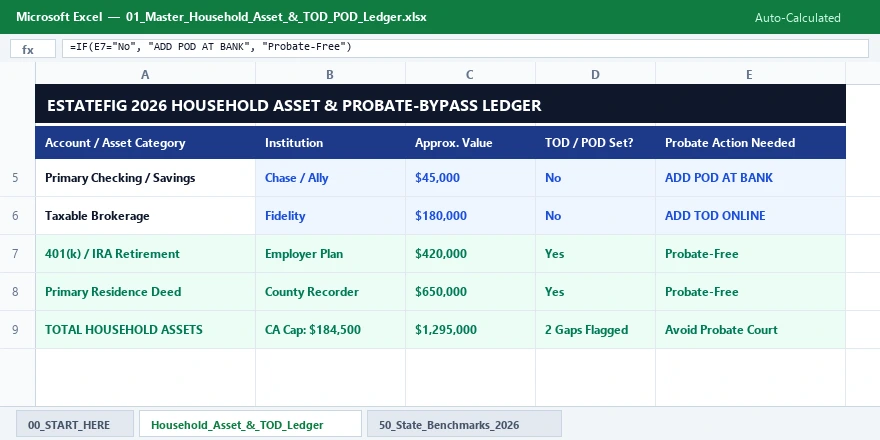
2026 Family Asset Inventory, DSUE Portability & Probate Shield
Editable Excel workbook + 50-state beneficiary & small-estate affidavit checklists. Keep sensitive family net worth 100% offline.
1. The Gross Value Trap: Why debt is never deducted
The single most financially devastating mistake California homeowners make is assuming probate fees are based on home equity. California courts determine fees using the inventory and appraisal value (Form DE-160) certified by a court-appointed probate referee.
If a decedent leaves a home appraised at $1,800,000 with a $1,200,000 mortgage, the net equity is only $600,000. However, statutory fees are assessed on the full $1,800,000 gross value: $4,000 (first $100k) + $3,000 (next $100k) + $16,000 (next $800k) + $8,000 (remaining $800k at 1%) = $31,000 for the attorney and $31,000 for the personal representative. A staggering $62,000 (over 10% of actual equity) is consumed by statutory fees alone.
2. Worked Numerical Comparison: Probate vs. Revocable Living Trust
Consider a typical California single-family home valued at $1,250,000 with an outstanding mortgage balance of $650,000 and $100,000 in bank accounts (Gross Estate: $1,350,000; Net Equity: $700,000):
• Under Statutory Probate: Attorney statutory fee is $26,500; Executor statutory fee is $26,500; Probate referee fee (0.1% of gross) is $1,350; Court filing fees and publication are ~$1,200. Total out-of-pocket probate expense: $55,550. Time to probate closure: 14 to 22 months in major county superior courts (Los Angeles, Orange, Santa Clara, Alameda).
• Under a Properly Funded Revocable Living Trust: Statutory probate is 100% bypassed. Successor trustee assumes administration immediately upon certification of death. Probate court fees: $0. Attorney trust administration review: typically $1,500 - $3,500 flat fee. Net savings for heirs: over $52,000, and title transfers within 30 to 45 days.
3. California Small Estate Affidavit threshold ($184,500 in 2026)
Under California Probate Code § 13100, estates with personal property not exceeding $184,500 (adjusted triennially under § 890) can bypass formal probate through a simplified Section 13100 Small Estate Affidavit without court appearance after a mandatory 40-day waiting period.
Crucial Warning: Real property (houses, condos, land) does NOT qualify for the Section 13100 personal property procedure if valued over $61,500. Even an entry-level mobile home or vacant parcel will push real estate into full formal probate unless held in trust, joint tenancy with right of survivorship, or under a recorded Revocable Transfer on Death (TOD) Deed under Cal. Prob. Code § 5600.
Calculate your exact California probate exposure in seconds using our California Probate Fee Calculator, or verify your deed status in our 50-State Estate Planning Checklist.
4. Step-by-Step Statutory Probate Defense Strategy
Step 1: Execute a California Revocable Living Trust with pour-over will and advance health care directive.
Step 2: Complete Trust Funding (Deeding Real Property). A trust is merely an empty shell until your grant deed is formally transferred from individual ownership to "Trustees of the [Family Name] Revocable Living Trust" and recorded with the County Recorder accompanied by a Preliminary Change of Ownership Report (PCOR).
Step 3: Designate Payable on Death (POD) / Transfer on Death (TOD) beneficiaries on non-trust checking, savings, and brokerage accounts to ensure immediate transfer outside probate jurisdiction.
Sources & Statutory Citations
California Probate Code § 10810 — Ordinary compensation of attorney for personal representative: leginfo.legislature.ca.gov
California Probate Code § 10800 — Compensation for personal representative services: leginfo.legislature.ca.gov
California Judicial Council Form DE-160 (Inventory and Appraisal): courts.ca.gov