
Massachusetts Estate Tax Cliff Guide (2026): Chapter 177 Acts of 2023 Rules & Credit Calculation
Historically, Massachusetts was notorious for possessing the nation’s most punitive estate tax "cliff"—if a decedent’s estate reached $1,000,001, the entire estate was taxed retroactively from dollar one, resulting in thousands of dollars in tax liability for exceeding the threshold by a single dollar. Following the enactment of Chapter 177 of the Acts of 2023 (M.G.L. c. 65C), Massachusetts permanently overhauled its estate tax code. This fiduciary guide breaks down the active 2026 rules, the $2,000,000 uniform credit calculation, and strategies for Bay State residents.
AEO Answer Box: Does Massachusetts still have an estate tax cliff in 2026?
No. Effective for decedents dying on or after January 1, 2023, Massachusetts abolished the retroactive cliff tax under Chapter 177 of the Acts of 2023. Massachusetts established a permanent statutory uniform estate tax credit of $99,600, which effectively shields the first $2,000,000 of Massachusetts taxable estate from tax. Only the value of the estate exceeding $2,000,000 is subject to Massachusetts estate tax at graduated rates starting at 7.2% and scaling to 16.0%.
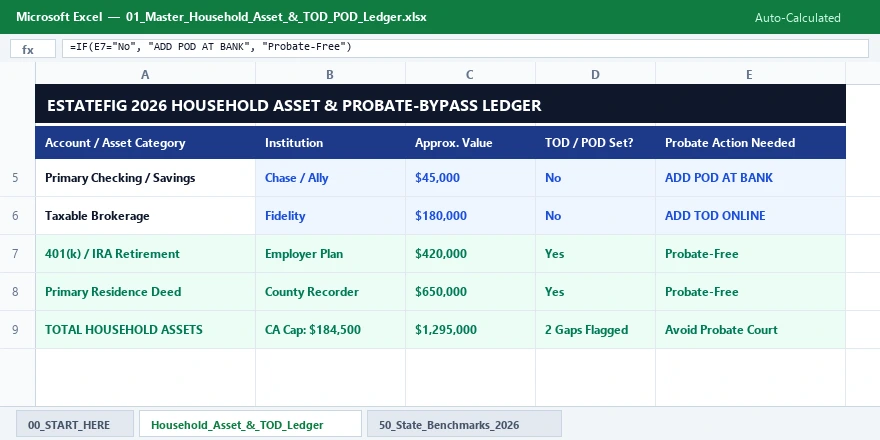
2026 Family Asset Inventory, DSUE Portability & Probate Shield
Editable Excel workbook + 50-state beneficiary & small-estate affidavit checklists. Keep sensitive family net worth 100% offline.
1. The Old $1M Cliff vs. The New 2026 $2M Unified Credit
Under prior Massachusetts General Laws c. 65C, Massachusetts tied its estate tax to the Internal Revenue Code in effect on December 31, 2000. If an estate was valued at $999,999, Massachusetts tax was $0. If the estate hit $1,000,001, the estate tax credit was wiped out entirely, and tax was calculated retroactively from dollar zero, assessing approximately $36,560 in tax on an estate that crossed the threshold by just $1.
Under the modern 2026 law (M.G.L. c. 65C, § 2A), the threshold was doubled to $2,000,000 and converted into a true credit of $99,600. Now, an estate valued at $2,050,000 is only taxed on the $50,000 excess, resulting in roughly $3,600 in net tax rather than an all-or-nothing cliff wipeout.
2. Worked Mathematical Example: Massachusetts Form M-706 Calculation
Let us compute the exact 2026 Massachusetts estate tax for a single resident decedent leaving an estate of $2,500,000 situated entirely in Middlesex County, MA:
• Gross Estate: $2,500,000.
• Tentative Tax under statutory rate table (M.G.L. c. 65C § 2A): $142,800.
• Statutory Uniform Credit: -$99,600 (shields the first $2,000,000).
• Net Massachusetts Estate Tax Due: $142,800 - $99,600 = $43,200.
• Effective Tax Rate on Total Estate: 1.73% (compared to over 5.7% under the old cliff system).
3. Out-of-State Property Apportionment Ratio
For Massachusetts residents who own out-of-state real property (e.g. a winter condo in Florida or vacation home in Maine), Massachusetts applies an apportionment formula under M.G.L. c. 65C § 2A(b):
• Tax Due = [Tentative Tax - $99,600] × [Massachusetts Taxable Assets ÷ Worldwide Gross Estate].
If a $3,000,000 estate has $1,500,000 in Massachusetts property and $1,500,000 in Florida real estate, Massachusetts only collects 50% of the calculated state tax. Conversely, for non-residents owning real property in Cape Cod or Boston, Massachusetts taxes the in-state real estate portion if worldwide assets exceed $2,000,000.
Model your exact state tax liability and portability alternatives on our Massachusetts Estate Tax Calculator and check other jurisdictions in our State Estate Tax Comparison Matrix.
4. Surviving Spouse Bypass Trust (Credit Shelter Trust) Planning
Crucially, Massachusetts does NOT recognize state-level portability of the $2,000,000 exemption between spouses. While the federal exemption ($15,000,000 per person in 2026) is fully portable via Form 706 DSUE election, an unused Massachusetts $2,000,000 exemption is permanently lost when the first spouse dies unless affirmative trust planning is utilized.
Solution: Married couples in Massachusetts should establish a Credit Shelter Trust (Bypass Trust / AB Trust). Upon the first spouse’s passing, $2,000,000 is allocated to the credit shelter trust, utilizing the first spouse’s Massachusetts exemption. The surviving spouse retains full income rights and principal access for health, education, maintenance, and support (HEMS). When the second spouse dies, the trust assets pass to heirs 100% free of Massachusetts estate tax, protecting $4,000,000 in combined wealth and saving the family up to $160,000 in state taxes.
Sources & Official Statutory Citations
Massachusetts Session Laws — Chapter 177 of the Acts of 2023: malegislature.gov
Massachusetts Department of Revenue (DOR) — Technical Information Release TIR 23-12 (Estate Tax Changes): mass.gov
Massachusetts General Laws c. 65C (Massachusetts Estate Tax): malegislature.gov